


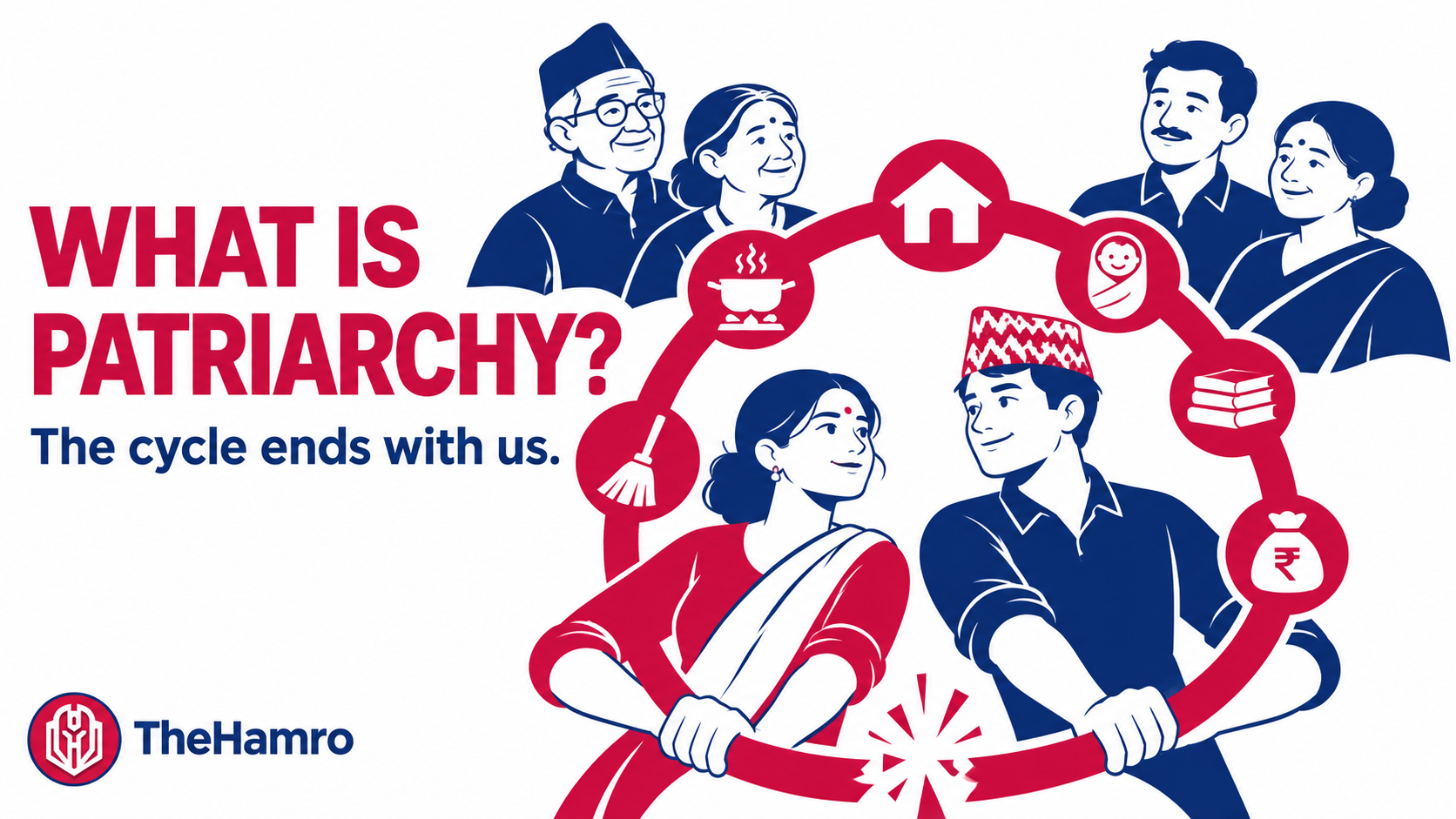
Who Keeps Patriarchy Alive?
All of us know about patriarchy, right? But what exactly is patriarchy?
What Is Patriarchy?
Patriarchy is a social system in which men hold primary power and authority, particularly in positions of leadership, decision-making, and control over resources. Historically, it has placed men in dominant positions, while women have often been expected to be subordinate, obedient, and confined to traditionally assigned roles. However, patriarchy is not limited to men controlling women. It is deeply embedded in our culture, traditions, family structures, social expectations, and even our everyday thinking. It influences how we raise children, divide responsibilities, whose opinions we value more, and what we consider acceptable behaviour for men and women.
Perhaps the most concerning part is that patriarchy is not perpetuated by men alone. Women, too, can internalise and reinforce patriarchal beliefs, sometimes without even realising it. And that is where I want to start this conversation.
Do you agree that our society is still patriarchal? Probably not. You might argue that we have equality now, that women are educated, independent, working, and holding positions of authority. And while these are significant achievements, does that necessarily mean patriarchy no longer exists?
Look closely, and you might find traces of it rooted deep in your own thoughts. Why? Because you were born seeing it. You experienced it while growing up. Even though you believe in equality, somewhere you might still feel that a man’s opinion carries more weight than a woman’s. Your father’s opinion might matter more to you than your mother’s. You might be more afraid of your father than your mother, even if he is rarely around. You might excuse certain behaviours in men simply because “men are like that”, while expecting women to behave differently.
These beliefs don’t necessarily mean you consciously support patriarchy. They are often things we absorb so early in life that we stop questioning them.
Now, let me ask you something. Can women be equally responsible for keeping patriarchy alive?
You might disagree. But hear me out.
The men in my life, my father, his brothers, and my own brother – they don’t seem to care about eating with me, sitting with me, or travelling with me during my periods. They don’t consider me untouchable. Yet it is my mothers who tell me, “You aren’t supposed to do that. Don’t touch your father or brothers during your periods.”
Controversial? Maybe. But it is my experience.
This raises an important question: Where did these beliefs come from, and why are they being passed down?
I am not suggesting that men have no role in perpetuating these traditions. Nor am I suggesting that women are responsible for the behaviour of every man they raise. Men have historically benefited from patriarchal structures, and many actively maintain them through their attitudes, decisions, and actions.
But we also need to acknowledge that women can become the guardians of the very traditions that restrict them.
Think about it. Many boys grow up watching their mothers serve the family, adjust their lives around their husbands, tolerate unequal expectations, and teach their daughters to do the same. They see their mothers enforcing restrictions on their sisters while they themselves are exempt from those restrictions.
A boy growing up in such an environment may learn that certain privileges naturally belong to him, not because someone explicitly tells him he is superior, but because that is what he repeatedly sees.
And a girl may grow up believing that sacrificing, adjusting, and obeying are simply what being a good woman means.
This is how patriarchy reproduces itself: not just through force or authority, but through everyday practices that eventually become normal.
In my opinion, we need to rethink the way we approach gender equality. Xori lai ghar ma thunne haina xora lai sanskar ramro dinu paryo. Tapai ko 25 barsa ko lathe xora lai khana paakauna aafu nabahye ximeki le dinu parne haina. Basic kam sab lai aaunu paryo gender-based stereotype ma rakhne haina.
Teach boys that no means no. Teach them consent, respect, accountability, and emotional intelligence. Teach them that women are not responsible for managing their behaviour or protecting their egos.
And teach boys that it’s okay to cry but not to make a woman cry.
We cannot keep telling girls how to protect themselves without teaching boys how to respect others.
Sadly, even in the 21st century, much of this remains limited to advertisements, campaigns, and social media posts rather than being practised in our homes.
Men are still being taught not to cry, while women are being taught not to offend men because MEN ARE MEN; THEY EARN FOR YOU TO LIVE LIKE THEY WANT.
I know how this sounds. I started talking about patriarchy, but now it might seem as though I am blaming women for men’s behaviour. That is not my intention.
A woman raising a son is not automatically responsible for every decision he makes as an adult. Men are individuals with their own agency and must be held accountable for their actions. But we cannot ignore the role families, particularly those who raise children, play in shaping their understanding of gender, power, and relationships.
And sometimes, the women passing down these beliefs are simply repeating what they were taught. Our mothers and grandmothers grew up in a society that rarely gave them the freedom to question these traditions. Many of them have spent their entire lives accepting restrictions as normal. Jasto sanskar, batawaran ma hurkiyo tei nai ma aafu basinxa paxi samma. We need to understand that before judging them.
But understanding where these beliefs come from does not mean we should continue practising them.
This festive season, I saw women on social media crying because they couldn’t celebrate due to their periods. I saw people handing over tikas and jamaras to them as if they were something untouchable. Some videos even showed elder sisters or mothers putting tika only on the foreheads of girls who were menstruating, keeping them separate from the usual celebrations.
And I kept wondering: tika nai lagadinu xa, include nai garnu xa ta sabai sangai rakhera manaunu na, xutayera tika lagako k artha bhayo?
This is where I struggle to understand the idea of PARAMPARA (tradition). At what point does a tradition stop being something meaningful and become a practice that reinforces inequality? Why should something be followed simply because generations before us followed it?
Menstruation is a biological process. Women aren’t impure or weak because they bleed every month, just as men aren’t superior or stronger simply because they perform certain kinds of labour.
Traditions should bring people together, not create unnecessary divisions between them.
And this brings me back to my original argument.
Women can be both victims and enforcers of patriarchy. They can experience discrimination and still unknowingly discriminate against other women. They can fight for their daughters’ education while teaching their sons that household responsibilities belong to women. They can demand respect for themselves while expecting their daughters-in-law to follow restrictions they once struggled with themselves.
This is not because women are naturally responsible for patriarchy. It is because social conditioning can make people defend the very systems that disadvantage them.
The responsibility to dismantle patriarchy cannot be placed on women alone. Men must question their privileges, challenge their own behaviour, and actively participate in creating equality. But women, too, need to recognise the power they hold in shaping families, raising children, and deciding which traditions deserve to continue.
We, the people of this generation, have an opportunity to break this cycle.
I’m trying to do that myself. I’m questioning things, doing what I believe is right, and hoping to raise the next generation with different ideas. I don’t want to pass down restrictions simply because they were passed down to me.
And why shouldn’t other women do the same? Why shouldn’t men do the same?
We need to stop confusing tradition with morality and obedience with respect. We need to stop teaching daughters how to adjust to inequality and start teaching sons not to create it.
People, regardless of gender, are shaped by what they see, where they grow up, and what they are taught. If there is something you dislike about the society you grew up in, question it. If a tradition makes someone feel inferior, excluded, or less human, question it. You might be considered the odd one for refusing to follow it today, but you might be the reason the next generation doesn’t have to question it tomorrow.
Patriarchy was built into our society over generations, and it will take all of us to dismantle it. The cycle doesn’t end by blaming one gender. It ends when we stop passing it on.