



Kathmandu, Nepal — A research team from Nepal has received the prestigious IEEE Best Paper Award for its research applying artificial intelligence and deep learning to agricultural disease detection, bringing international recognition to research being carried out by young Nepali engineers and researchers.
The award-winning research, titled “An Efficient Deep Learning Based Mobile Application for Pigeon Pea Disease Classification,” was presented at an IEEE International Conference on ICT and Photonics. The research team comprises Prabhat Kumar Chaudhary, Ujjwal Kumar Karn, Santosh Kumar Chaudhary, Deepika Neupane, Rajiv Kumar Yadav, Prof. Deepesh Prakash Guragain, and Prof. Bijaya Shrestha.
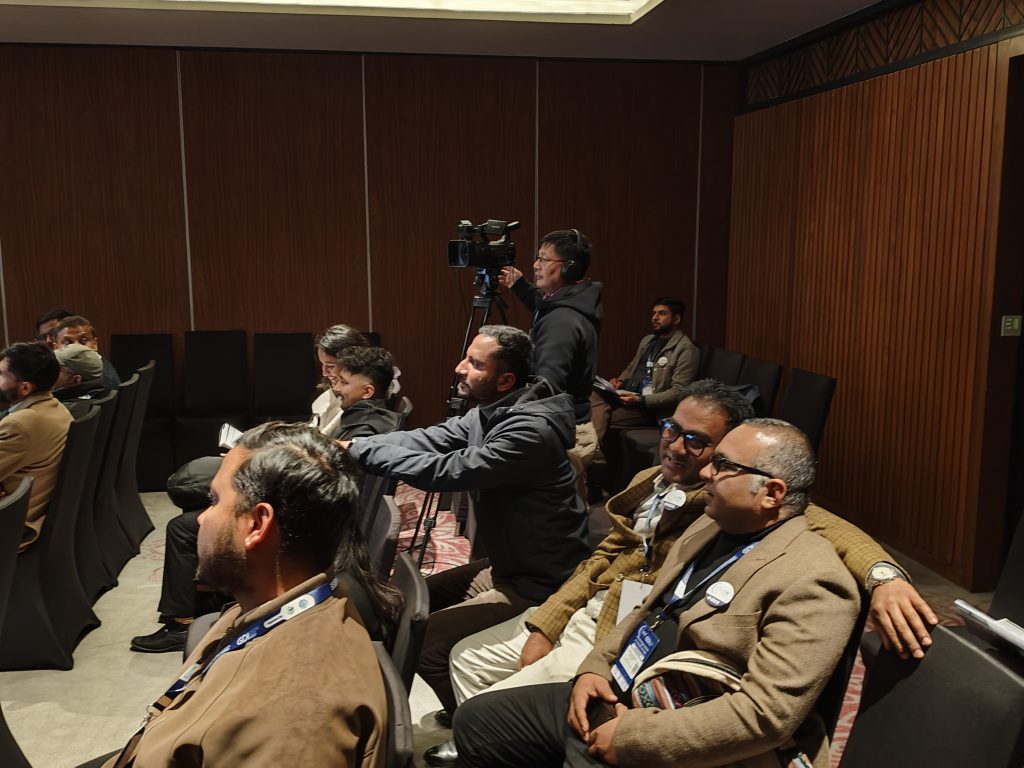
Among the research team, Prabhat Kumar Chaudhary, an Electronics and Communication Engineering student at Nepal Engineering College, Pokhara University, served as the first author of the award-winning paper and was closely involved in the development of the proposed deep learning-based disease classification system. The work focused on developing the machine-learning pipeline, investigating the classification approach, and translating the research into a practical mobile-based application capable of performing disease identification directly on a device.
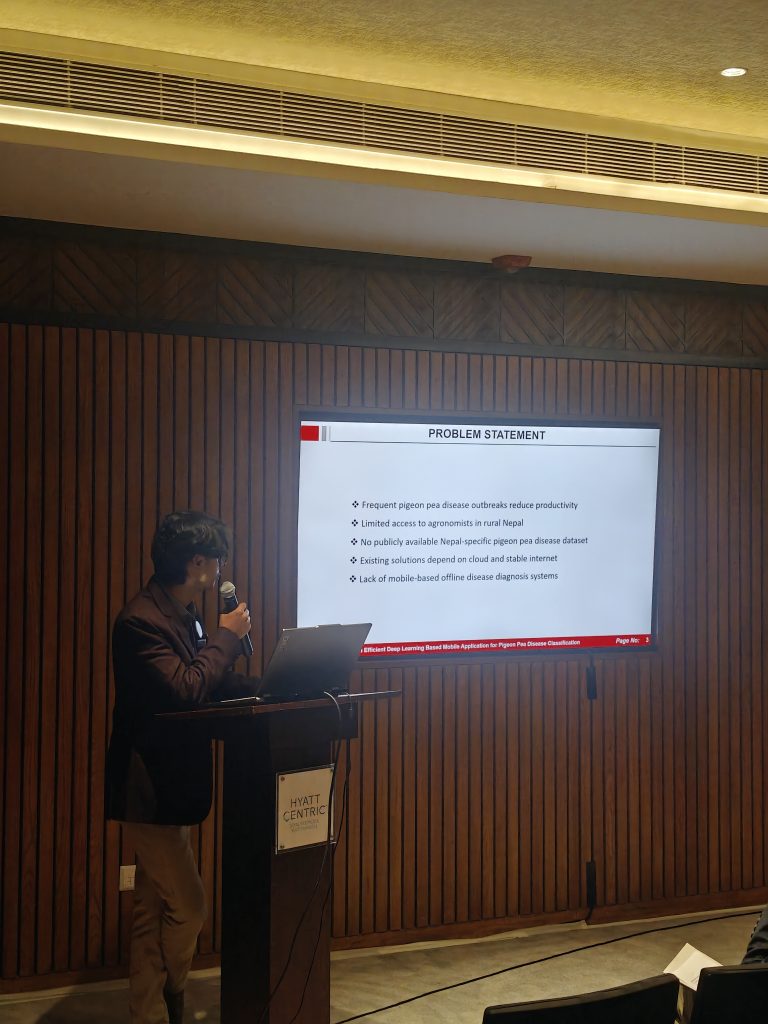
The research addresses a significant challenge faced by pigeon pea, locally known as Rahar, farmers in Nepal: the timely and accurate identification of crop diseases. According to the study, disease outbreaks can substantially affect pigeon pea production, while farmers in rural and remote areas may have limited access to agricultural experts. Traditional visual inspection can also be time-consuming and susceptible to subjective judgment, potentially resulting in delayed or inaccurate diagnosis and inappropriate pesticide use.
To address this challenge, the researchers developed an artificial intelligence-based system capable of identifying pigeon pea diseases from leaf images. A major component of the research was the creation of a locally collected dataset containing 7,930 pigeon pea leaf images, gathered from farms and surrounding agricultural areas in Chitwan, Nepal. The images were collected under varying lighting conditions, backgrounds, viewing angles, devices, and plant growth stages, with the aim of making the dataset more representative of real agricultural environments in Nepal.
The dataset contains eight categories: Healthy, Insect (Pod Borer), Halo Blight, Sterility Mosaic, Alternaria Blight, Fusarium Leaf Blight, Bracteomania, and Phytophthora Blight. The researchers worked with an agronomist for disease labeling before preprocessing the images through resizing, normalization and augmentation techniques. The dataset was subsequently divided into training and validation sets for development and evaluation of the deep learning model.
At the core of the system is a VGG16 convolutional neural network, initialized with weights pretrained on ImageNet and fine-tuned for pigeon pea disease classification. The model was trained using the Adam optimizer with a learning rate of 0.0001 over 20 epochs, with dropout regularization used to reduce the risk of overfitting. The experiments were conducted using Google Colab with a Tesla T4 GPU, after which the trained model was converted into TensorFlow Lite format for deployment on resource-constrained devices.
The resulting model achieved an overall 98 percent classification accuracy, with a macro-average F1-score of 0.96 and a weighted-average F1-score of 0.98. Several classes, including Bracteomania, Healthy, and Insect (Pod Borer), achieved particularly strong classification performance, demonstrating the model’s ability to distinguish between different disease and pest categories from leaf images.
A key aspect of the research was that the researchers did not stop at developing a high-performing model in a laboratory environment. The trained model was optimized using TensorFlow Lite and integrated into an Android mobile application, allowing disease classification to be performed directly on a smartphone without requiring continuous internet connectivity. The optimized model reduced its size from approximately 183 MB to 80.6 MB, while the reported average inference time decreased from 711.18 milliseconds to 545.03 milliseconds per image, with substantially lower device memory and power requirements.
The mobile application uses the device’s camera to capture images of pigeon pea leaves, which are then processed by the embedded VGG16-based model to identify diseases and pest damage. The application was designed with a lightweight and user-friendly interface intended for practical field deployment, particularly in environments where reliable internet connectivity may not always be available.
The research is particularly significant because it was developed around a Nepal-specific, field-collected dataset, addressing a gap identified by the researchers in existing pigeon pea disease research. Much of the previous work in the area has relied on general or preprocessed datasets, while locally collected data can better reflect the agricultural and environmental conditions encountered in Nepal. The study therefore combines deep learning with an approach focused on real-world applicability rather than solely on laboratory-based classification performance.
For Prabhat Kumar Chaudhary, the recognition represents an important milestone in his emerging research career. As the first author of the paper, his involvement in the development of an AI-based system that moves from field data collection and model development to optimized on-device deployment demonstrates a practical research approach connecting artificial intelligence, computer vision, mobile computing, and agricultural technology.
The achievement also reflects the broader research efforts of the entire team. Ujjwal Kumar Karn, Santosh Kumar Chaudhary, Deepika Neupane, Rajiv Kumar Yadav, Prof. Deepesh Prakash Guragain, and Prof. Bijaya Shrestha contributed to the research effort that led to the development and presentation of the award-winning work. The paper acknowledges Nepal Engineering College for providing a research platform and encouraging undergraduate students to undertake research with practical impact.
The IEEE Best Paper Award recognizes outstanding research presented at an IEEE conference and represents a notable achievement for researchers at any stage of their careers. For a team of researchers working on an agricultural problem originating in Nepal, the recognition provides particular visibility to the potential of locally developed technological solutions to address challenges faced by communities and industries.
The award-winning work demonstrates how artificial intelligence can be adapted beyond conventional applications and applied to challenges directly connected to agriculture and food production. By combining a locally collected dataset, deep learning, mobile computing, and offline inference, the researchers have developed a system aimed at making advanced disease detection technology more accessible in field environments.
The team plans to further develop the system by expanding the dataset to include additional disease categories, incorporating disease severity estimation, exploring lighter and more computationally efficient models, and introducing multilingual support to improve accessibility and adoption among farmers across different regions.
For the researchers, the IEEE Best Paper Award is therefore more than recognition for a single publication. It represents an encouraging milestone for emerging research from Nepal and highlights the ability of young Nepali engineers to develop and present internationally recognized work at the intersection of artificial intelligence, computer vision, and practical engineering applications.