


Executive Summary
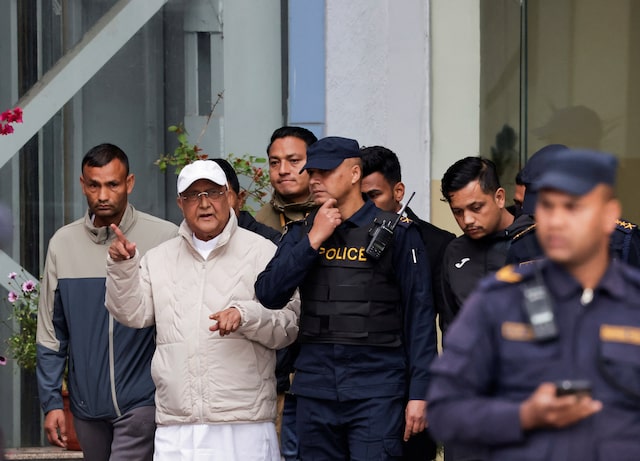
On March 28, 2026, K. P. Sharma Oli, former Prime Minister of Nepal, was arrested at his residence in Kathmandu on charges of culpable homicide and criminal negligence. This arrest represents a watershed moment in Nepal’s modern political history and marks the first significant legal prosecution of a former head of government. The action reflects the culmination of a year-long political crisis triggered by the violent suppression of youth-led protests in September 2025, during which at least 76 people were killed. The arrest signals the new government’s commitment to accountability and judicial reform.
1. BACKGROUND: THE 2025 GEN Z PROTESTS
Origins of the Movement
In September 2025, Nepal witnessed a massive wave of anti-government protests led primarily by students and young citizens. The initial catalyst was a controversial government decision to ban multiple social media platforms. However, this ban quickly became a flashpoint for broader grievances surrounding corruption, governance failures, and lack of transparency within the government.
Escalation and Violence
Within days, protests spread across the country, escalating from peaceful demonstrations into a nationwide uprising. Confrontations between demonstrators and security forces intensified rapidly, with government buildings attacked and public anger reaching critical levels. The situation deteriorated when security forces opened fire on protesters, resulting in at least 76 deaths during just two days of unrest and over 2,000 injured. The scale of violence shocked the nation, ultimately forcing Oli to resign from office on September 9, 2025.
2. INVESTIGATION AND CHARGES
Government Investigation Commission
Following the violent suppression of the protests, the government appointed an investigation commission to examine the causes of the violence and determine accountability. The commission conducted a thorough review of the government’s response and decision-making during the crisis period.
Key Findings
The commission’s findings were highly critical of Oli’s administration, concluding that:
- The government failed to act responsibly during the crisis
- No effective effort was made to stop prolonged police firing on protesters
- Leadership acted with criminal negligence in managing the situation
Specific Charges and Recommendations
The investigation panel specifically accused K. P. Sharma Oli and then-Home Minister Ramesh Lekhak of criminal negligence. The commission recommended prosecution for both officials, with potential sentences of up to 10 years in prison if found guilty. These findings intensified public demand for justice, particularly among victims’ families and youth activists.
3. POLITICAL SHIFT AND ELECTORAL CONSEQUENCES
2026 General Elections
The political fallout from the 2025 protests significantly reshaped Nepal’s electoral landscape. In the 2026 general elections, Oli suffered a major electoral defeat, losing to Balendra Shah, a former rapper-turned-politician who emerged as a powerful symbol of political change.
Rise of Balendra Shah
Shah’s rise to power reflected a broader public desire for accountability and reform. His party’s electoral victory was largely fueled by anger generated during the 2025 protests and widespread demand for justice. The new government made clear that legal accountability would be a priority.
Swift Action
Notably, Oli’s arrest came just one day after Shah officially assumed office as Prime Minister on March 27, 2026, signaling the government’s intent to act swiftly on the investigation commission’s recommendations.
4. THE ARREST: MARCH 28, 2026
Operational Details
On the morning of March 28, 2026, police officers arrived at Oli’s residence in Kathmandu and took him into custody. The operation involved multiple security personnel and was conducted under official orders following the investigation report, executed in accordance with standard legal procedures.
Related Arrest
Alongside Oli, former Home Minister Ramesh Lekhak was also arrested in connection with the same case. Both were detained under charges related to culpable homicide and negligence in handling the 2025 protests.
Official Statements
Authorities emphasized that the arrests were part of a legal process aimed at ensuring justice and accountability rather than political retaliation. Nepal’s Home Minister stated that the move reinforced the principle that no individual, regardless of former status, is above the law.
5. LEGAL PROCEEDINGS AND HEALTH CONCERNS
Post-Arrest Procedures
Following his arrest, Oli was taken to a police facility and subsequently transferred to a hospital due to health concerns, given his documented history of serious medical conditions.
Defense Arguments
Oli’s legal team has strongly criticized the arrest, arguing that it was unnecessary and lacked proper legal justification, claiming that Oli was not a flight risk and could have cooperated without detention.
Upcoming Court Proceedings
Both Oli and Lekhak are expected to face court proceedings where charges will be formally reviewed and adjudicated.
6. NATIONAL AND INTERNATIONAL SIGNIFICANCE
Historical Precedent
The arrest of a former Prime Minister is rare in Nepal’s political history. It represents a shift toward greater accountability in governance and reflects the growing influence of public opinion, particularly among younger generations.
Civic Power and Political Outcomes
The case highlights the extraordinary power of civic movements in shaping political outcomes. The 2025 Gen Z protests not only led to the fall of a government but also initiated legal action against top political leaders.
International Perspective
Internationally, the incident has drawn attention as an example of democratic accountability, though it has also raised questions about political stability and the potential for legal processes to be influenced by changing political dynamics.
7. CONCLUSION
The arrest of K. P. Sharma Oli on March 28, 2026, is far more than a legal development—it is a defining moment in Nepal’s democratic journey. Emerging from the ashes of the 2025 protests, it underscores the increasing demand for transparency, justice, and responsible leadership in governance.
As the case proceeds through the judicial system, its outcome will likely have long-term implications for Nepal’s political culture, governance standards, and the relationship between the state and its citizens. Whether this moment becomes a turning point toward sustainable democratic reform remains to be seen, but the arrest itself represents a significant shift in Nepal’s approach to governmental accountability and the rule of law.